J&K Statehood Debate Deepens as Sunil Sharma Targets NC Government Over Governance
By: Javid Amin | 16 September 2026
Baramulla: Jammu and Kashmir’s political debate over restoration of statehood has entered another sharper phase, with Leader of Opposition Sunil Sharma arguing that the demand for statehood cannot become a substitute for answering questions about governance.
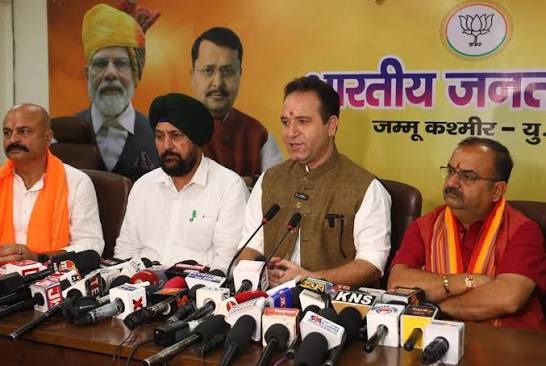
Speaking to reporters in Baramulla on Wednesday, Sharma, a senior BJP leader and the Leader of Opposition in the J&K Legislative Assembly, accused the National Conference-led government of failing to make effective use of the powers, funds and administrative resources already available to it.
His argument goes to the heart of the political contest that has increasingly defined J&K since the 2024 Assembly elections: statehood is a constitutional and political demand, but governance is an everyday test.
For the National Conference government, restoration of statehood remains one of its central political demands. For the BJP opposition, however, the question is increasingly whether the administration can demonstrate results while Jammu and Kashmir remains a Union Territory.
That distinction is becoming more important as the debate moves beyond constitutional status and into issues that directly affect households, job seekers, employees, businesses and local communities.
Sunil Sharma turns statehood debate towards governance
Sharma’s latest attack was not limited to statehood.
He raised concerns about unemployment, alleged corruption, the use of outsourcing for employment, electricity charges and the implementation of centrally funded schemes. He also said the opposition would continue raising the concerns of National Health Mission employees, daily-wage workers and Anganwadi workers.
His central political message was straightforward: the elected government has responsibilities to fulfil with the powers it already possesses.
The BJP’s argument has appeared repeatedly in recent months. In July, Sharma accused the National Conference of using its proposed Delhi protest over statehood to shift attention away from governance issues. In September, he challenged Chief Minister Omar Abdullah to seek a fresh mandate if statehood was to be treated as the defining issue before the people.
The latest Baramulla remarks therefore represent less a new line of attack than a continuation of an increasingly organised opposition strategy.
The BJP is attempting to place two questions side by side: when will J&K regain statehood, and what is the elected government doing with the authority it already has?
Statehood remains a central NC demand
For the National Conference, the statehood question is not merely an electoral slogan.
The party returned to government after the 2024 Assembly elections, campaigning on issues including dignity, identity, development and restoration of statehood. After taking office, the Omar Abdullah Cabinet adopted a resolution seeking restoration of statehood.
The demand also has a wider constitutional backdrop.
Jammu and Kashmir was reorganised as a Union Territory in 2019 following the abrogation of the former constitutional arrangement surrounding Article 370. The Supreme Court, while upholding the constitutional changes in December 2023, also recorded the Union government’s assurance that statehood would be restored to Jammu and Kashmir.
The Assembly elections eventually took place in 2024, followed by the formation of an elected government under Omar Abdullah.
That has left statehood in a politically unusual position. Jammu and Kashmir has an elected legislature and Council of Ministers, but it does not possess the full constitutional status that the region had before the 2019 reorganisation.
For the NC, restoration is therefore closely tied to the question of political authority and institutional dignity.
For the BJP, the argument is increasingly that statehood and governance should not be treated as mutually exclusive issues.
Electricity becomes an immediate test
Among the issues raised by Sharma, electricity has a particularly tangible political dimension.
The Joint Electricity Regulatory Commission approved the FY2026-27 tariff structure for Jammu Power Distribution Corporation and Kashmir Power Distribution Corporation in August.
The order provides for subsidised tariffs from September 1, 2026, backed by a substantial subsidy commitment from the J&K government. At the same time, the approved structure reflects an average tariff increase of 6.83 percent compared with the previous year when calculated at the average tariff level.
For consumers, however, an average figure does not tell the entire story.
The actual impact depends on the category of consumer, consumption level, fixed charges and other provisions. The order also introduces time-of-day tariff provisions for consumers with sanctioned load or contract demand above 10 kW, excluding agricultural consumers, subject to compatible metering and billing infrastructure.
This creates a complicated political picture.
The government can point to subsidy support and efforts to restructure the electricity sector. The opposition can point to higher approved tariffs and the continuing public concern over electricity supply and affordability.
Both elements can exist simultaneously.
The real test for the administration is therefore not simply whether tariffs have increased. It is whether consumers experience more reliable supply, better billing, fewer service complaints and improved financial sustainability in the power sector.
Jobs remain the most sensitive political issue
Employment is another area where political claims need to be separated from measurable data.
There is no question that jobs remain a major concern in Jammu and Kashmir, particularly among young people. But unemployment statistics vary substantially depending on the definition used, the age group covered and whether the survey measures current weekly status or another labour-market indicator.
The latest available PLFS data for 2024-25 put J&K’s overall unemployment rate among people aged 15 and above at 4.9 percent under the combined usual-status measure.
The picture becomes different when the focus shifts specifically to youth.
A Mission YUVA baseline survey for 2024-25 cited a youth unemployment rate of 17.4 percent. That figure helps explain the intensity of political concern surrounding jobs, although it should not be presented as interchangeable with the broader PLFS unemployment rate.
The distinction matters because a young graduate searching for a government job experiences the labour market differently from the overall working-age population.
That is why employment is likely to remain one of the most politically consequential issues in the Assembly.
At the same time, the government can point to recruitment and appointments taking place under its administration. On September 15, Omar Abdullah handed appointment orders to 55 candidates selected through the Combined Competitive Examination for the J&K Administrative Service and J&K Accounts Service.
The existence of recruitment does not settle the larger employment question. Nor do allegations of outsourcing, by themselves, establish that government recruitment has collapsed.
The more important issue is whether J&K can create enough stable, productive employment outside the limited pool of government posts.
Opposition expands its ground-level campaign
Sharma’s Baramulla visit also came as the BJP legislature party stepped up its district-level outreach before the Assembly session.
The opposition has been meeting employees, traders, contractors, workers and other groups, collecting grievances that can subsequently be raised inside the Assembly.
This is politically significant.
A statehood debate takes place largely at the constitutional and political level. Employment disputes, electricity bills, pending wages, recruitment delays and service delivery problems are much closer to people’s daily lives.
By connecting the two, the BJP is attempting to change the frame of the political argument.
Instead of allowing the statehood issue to dominate every discussion, it wants the government to answer a second set of questions: What has improved? Which promises have been delivered? Where are public funds going? Why are certain services still facing problems? What is being done about unemployment?
The coming Assembly session is therefore likely to become an important arena for this contest.
Congress occupies a more complicated space
The political equation is not simply NC versus BJP.
Congress is part of the broader political alliance that helped the NC-led government emerge after the 2024 election, while also maintaining its own organisational and political positions.
The party has supported restoration of statehood, but its relationship with the NC government has not always been free of differences.
This creates an unusual political situation in which the ruling arrangement and the opposition can agree on the broad demand for statehood while disagreeing over how strongly the government is delivering on everyday governance.
That distinction could become more visible as the Assembly’s political life matures.
From Article 370 to statehood, the argument has changed
The political vocabulary of J&K has changed significantly since August 2019.
Immediately after the reorganisation, the principal political dispute centred on Article 370, constitutional status and the division of the former state into two Union Territories.
The 2024 Assembly election changed the setting.
An elected government returned to office, giving political parties a functioning legislature through which they could fight over development, employment, electricity, infrastructure and administrative performance.
Statehood nevertheless remained unresolved.
That has produced a political overlap. The NC can argue that the current constitutional structure limits the authority of the elected government. The BJP can respond that the government still possesses substantial administrative responsibilities and should be judged on how it exercises them.
Neither argument automatically eliminates the other.
That is perhaps the central tension in J&K politics in 2026.
What the statehood debate means for ordinary people
For political parties, statehood carries questions of constitutional authority, representation and institutional power.
For ordinary residents, however, the political hierarchy can look different.
A job applicant wants recruitment to happen on time.
A household wants dependable electricity at an affordable cost.
A daily-wage worker wants wages released.
An NHM employee wants clarity about service conditions.
A trader wants functioning infrastructure and predictable regulations.
A rural resident wants roads, water and healthcare.
These concerns do not disappear while statehood is being debated.
That is the point Sharma is trying to turn into a political weapon against the NC government.
But the reverse is also true: better governance would not remove the political demand for restoration of statehood.
The two questions are therefore not necessarily competing priorities.
The next battle moves into the Assembly
The forthcoming Assembly session is likely to bring this conflict into sharper focus.
The opposition has already signalled that employment, electricity, centrally funded schemes, workers’ grievances and administrative performance will be raised.
The government, meanwhile, is expected to continue pressing the Centre on statehood while defending its record on development and administration.
The political challenge for the NC is straightforward but substantial: demonstrate that its campaign for statehood does not come at the expense of day-to-day governance.
For the BJP, the challenge is different: turn criticism into sustained legislative scrutiny rather than allowing the argument to remain limited to press conferences and political rallies.
And for Congress, the balancing act will be even more delicate, as it seeks to support the statehood demand while maintaining its own political space within and around the alliance.
Statehood and governance are now inseparable political questions
The latest confrontation in Baramulla reflects a broader transformation in J&K politics.
The debate is no longer only about whether Jammu and Kashmir should regain statehood. It is also about what an elected government can and should accomplish before that restoration happens.
Sunil Sharma’s intervention gives the opposition a clear line of attack: statehood should not become an explanation for every governance problem.
The National Conference’s counter-position is rooted in the larger constitutional question: an elected government operating without full statehood does not have the same institutional framework as the former state government.
Both arguments will continue to collide.
But ultimately, the political significance of the debate will be measured not only in speeches about Delhi, Article 370 or statehood. It will also be measured in electricity bills, recruitment notices, functioning public services, wages, roads, schools and the confidence of young people searching for work.
For Jammu and Kashmir’s voters, those are not separate political stories.
They are increasingly part of the same question: what kind of government should J&K have, and how effectively is the government it has today using the powers available to it?